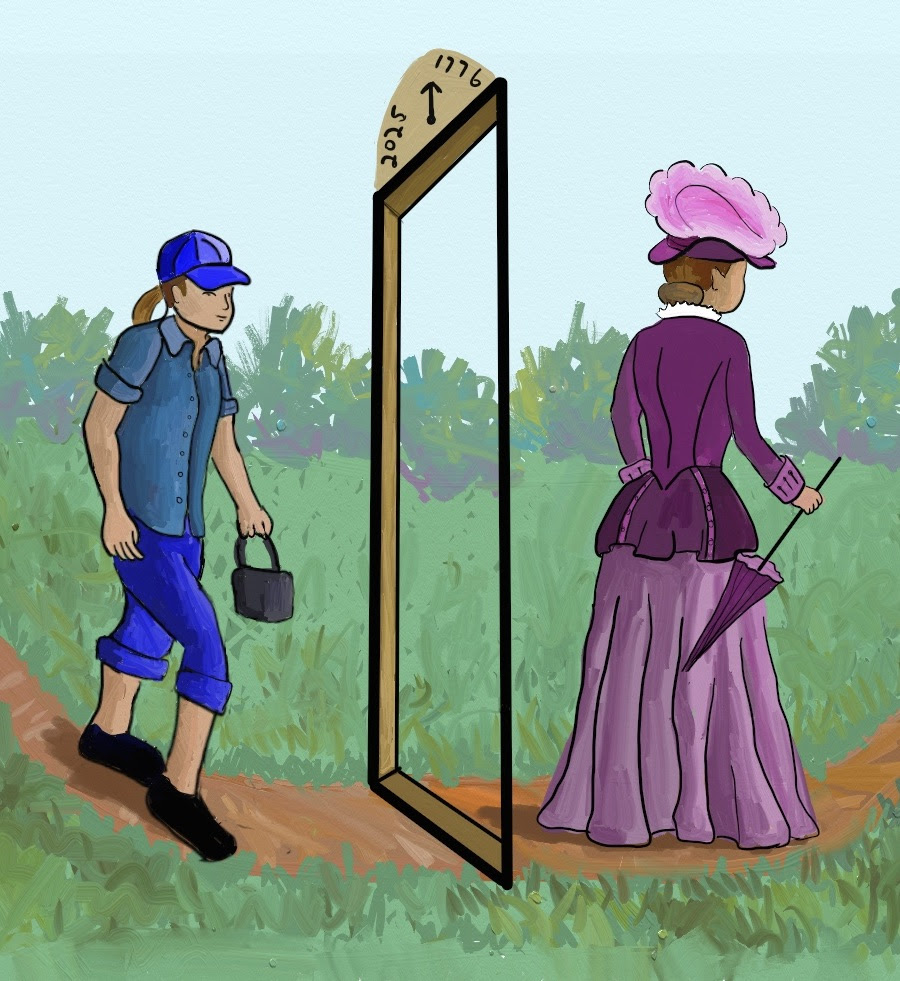
In the last few newsletters we’ve been exploring various tools authors use to add depth and interest to their stories. The research has been fascinating. Today’s example is time travel, a device used by many authors, but not children’s book authors. Since small children are still trying to interpret real time, we don’t confuse the issue with flash backs, flash forwards, or time travel in their literature.
For our older audiences, who have at least some grasp of reality, stories involving time travel are engaging and so much fun! Authors’ use of time travel in science fiction and fantasy has been around for centuries, and shows no signs of diminishing soon. The earliest examples of traveling to the future (H. G. Wells’ The Time Machine written in 1895) and to the past (Mark Twain’s A Connecticut Yankee in King Arthur’s Court written in1889) captivated readers with the excitement of new dimensions, locales, and strange characters.
The use of time travel presents the author with a set of rules, but even navigating through the minefield of these constraints is fun, too. Paramount among the author no-nos is ‘The Grandfather Paradox.’ A protagonist can’t go back in time and kill his young grandfather, thus preventing his own birth, and subsequent ability to travel back.
Another head-scratcher is ‘The Bootstrap Paradox.’ This conundrum got its name from the saying “Pull yourself up by your bootstraps,” which defies the laws of physics. In literature, ‘The Bootstrap Paradox’ happens when you send an object back in time from the present. It then has no point of origin in that time period. An example is Robert Heinlein’s short story By His Bootstraps. The protagonist receives a notebook from his future self, and sends the notebook to his past self. He’s created a loop, with no clear origin of the notebook.
‘The Predestination Paradox’ sets the reader spinning in a time travel spiral where people go back in time to prevent something bad that is happening in the present, but their efforts have the opposite effect, and actually cause the event.
Authors have used the tool of time travel not only to add layers of intrigue, but also to comment on social and political issues, explore philosophical concepts, and present thorny questions. Controversial thought-provoking subjects are made much more palatable by story-telling.
Suggested time travel books:
– Kurt Vonnegut: Slaughterhouse-Five (1969)
– Stephen King: 11/22/63 (2011)
– Audrey Niffennegger: The Time Traveler’s WIfe (2023)
– Diane Gabaldon: The Outlander series (1991)
Please come meet over 100 authors at the Desert Foothills Book Festival, Saturday, October 18, 2025, from 10 a.m. to 3 p.m. Admission is free, and the first 100 people will receive a welcome gift worth $60!
The Holland Center, 34250 N 60th Street, Scottsdale, AZ 85266Time Travelling