National Tell a Story Day is celebrated annually on April 27 in the US to encourage sharing tales, myths, and personal stories. The suggested protocol for celebrating this holiday is to tell a story, true or fictional, to a friend, and to listen to theirs. I think storytelling is the most effective method of communication, and my way of celebrating this year is to write about the tools people have used through the ages to preserve and share their stories.
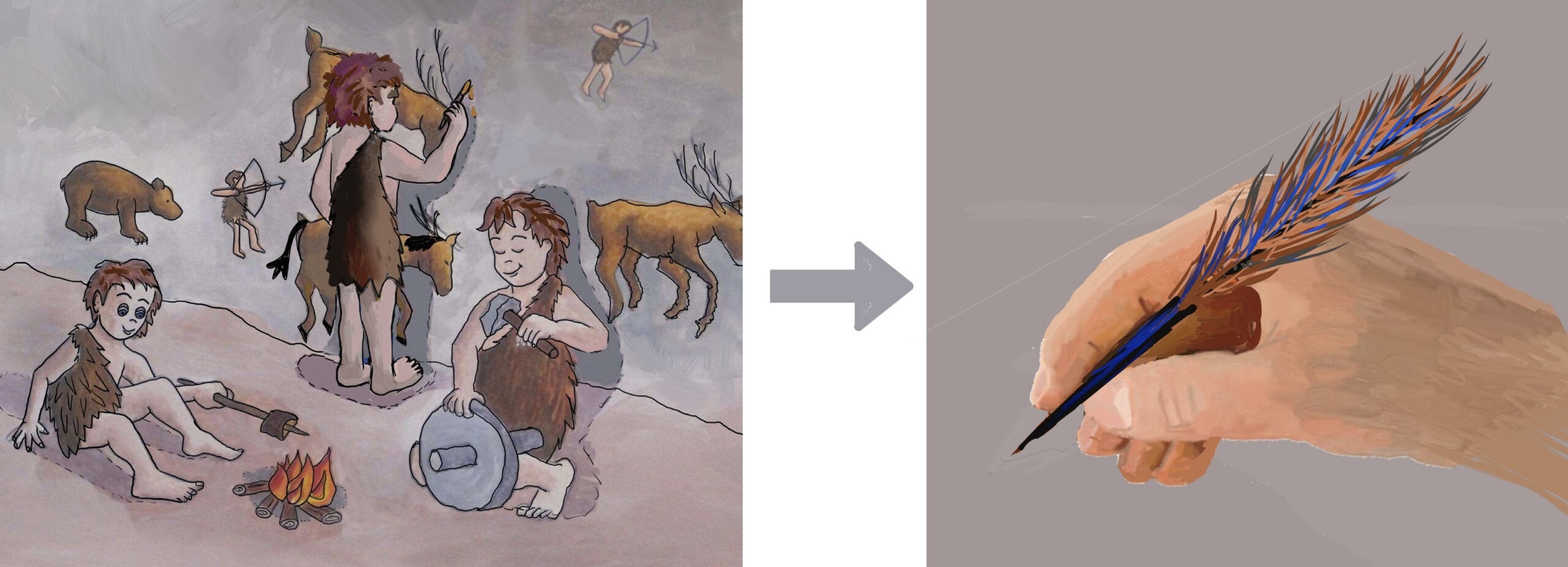
The cave paintings in Lascaux, France, appear to be our earliest evidence of storytelling. Those Paleolithic images, about 20,000 years old, used pictures to tell stories about animals in the region (horses, stags, cattle, felines, even a bear and a rhino!) They also chronicled human activities, like hunting and battles. The mark-making tools were surprisingly sophisticated. There were paints with mineral pigments, implements to incise into stone, and even hollowed-out bones for an airbrush technique. People blew paint through them with their mouths.
As millennia passed, humans evolved from writing on walls to using more portable means of recording their stories. About 5000 years ago, they started using reeds to press marks into wet clay, which they then baked to make permanent. The writing skills of Egyptians became even more polished when they started using reed pens with carbon ink on papyrus. The clever Romans used thin metal rods to write on wooden tablets covered with wax. They could correct mistakes by smoothing out the wax with the flat end of the stylus.
As writing implements marched through history, quill pens were popular from the time of their introduction around 600 AD up to the Industrial Revolution in the 1800s. Feathers, usually goose, swan, or turkey, were messy and fragile, they required frequent sharpening, and left ink blots. These pens were a lot better than their predecessors, but still had an annoyance factor, which, when coupled with necessity, became the mother of invention.
I love research almost as much as writing. My further rabbit-hole explorations gave birth to another newsletter, taking us into the Industrial Revolution, typewriters, the printing press, computers, and beyond. I’ll be sending you that next month. Readers, please send me suggestions for literature-themed topics for future newsletters. I’d love to hear from you.
As literature fans, you’ll enjoy the fifth annual Desert Foothills Book Festival on Saturday, October 17, 2026, from 10 am to 3 pm at The Holland Center, 34250 N 60th Street, Scottsdale, AZ. Admission is free, and the first 100 attendees receive a free prize. The event will be held both outdoors and indoors and will include food trucks, raffles, and giveaways. Come visit over 100 authors and their books, which represent a variety of genres. I’ll see you there!
Rita Goldner